Showing posts with label assessment. Show all posts

Wednesday, March 26, 2014

A New Way to Teach Descriptive Writing

Some of my lower level English students struggle with understanding the impact of descriptive writing. They understand what an adjective does and what its function is in a sentence, but translating that to a larger scale and applying that concept to descriptive writing in a story is very difficult for them to do. After trying a couple of techniques to increase their ability to identify descriptive writing and becoming frustrated, I decided to have the students "DO" instead of just "LISTEN."

I only had four students in this class on this day and I could really take the time to show them what they were missing and where they needed to go. I placed them at different points around the school and had them look at the scene in front of them. I told them to write down all of the adjectives that they could think of to describe what they were looking at in 1 minute.

I timed them and once they were finished with that scene, they rotated clockwise to the next scene. Once they were finished with all of the scenes, I had them come back to the classroom where I drew a table on the board and wrote their names across the top and the title of each scene along the side. Each student recited the adjectives they thought of to describe each scene and I wrote them on the board. We discussed the different adjectives and I asked them if they saw any trends in the adjectives they chose.


The #1 trend they noticed was that almost all of the adjectives they chose were colors but there wasn't anything to describe the temperature, the sounds, the sights, the smells, the change in texture, sunlight, or perspective. I wrote a list of the five senses on the board and asked them to re-do one scene from outside using their five senses, and find adjectives to describe the scene that addressed each sense.

Once more, we went back inside after the minute was up and I wrote their new adjectives on the board next to their previous choices. It became obvious that these new adjectives made a huge difference in describing what they saw and to further make this point, I gave each student a different student's list and asked them to write a paragraph using the new adjectives.

One student only came up with two new adjectives and to the student who had to write a paragraph using only two adjectives, it soon became apparent that in order to write a paragraph, you needed more than two adjectives to describe a scene.

This exercise not just TOLD them but SHOWED them how important descriptions were to the development of the setting. In a story, instead of only reading the words, I want them to be more aware of how the author is creating the setting by accessing their five senses to create a comprehensive experience for the reader. I want them to to be able to identify when descriptive writing is being used and how it affects the development of the story.


Tuesday, August 20, 2013

English IV is going to be a fun class!

I have a great group of boys in this class and they are all very interesting and dynamic but require a strong hand when getting into their work and producing some quality results. Most are ridiculously intelligent but lazy as they come so to inspire them, I decided to do a unit on the concept of insanity and who, what, or how insanity is determined. We are reading three books this semester, Macbeth by William Shakespeare, Frankenstein by Mary Shelley, and One Flew Over the Cuckoo's Nest by Ken Kesey.

All amazing books and I thoroughly enjoy teaching them and the subject matter. However, I let them know today that they are responsible for the way the class is going to be. If they don't do their homework, it will be a silent reading experience with everyone individually completing their work- OR they can complete their homework at home so we can have interesting and dynamic discussions about controversial topics and issues. Most of these students have had me before and appreciate my frank and honest explanations about everything we read or discuss so they know that in order for me to put in the effort to coordinate these discussions, they need to do their part, but I wonder how some of the new students will react.

It will be interesting to observe the different pressures from the students who want to discuss the book and topics on the students who just want to slack off. I told them it was all or nothing and I hope I didn't make a mistake by doing that because I know they want to slack off but also really want to talk about things that most other classes would never consider discussing. I think this will be my favorite class this year but it requires a ton of energy to teach and I have SO much on plate with the other 3 different levels of English I am simultaneously teaching IN ADDITION to being the College Counselor and Academic Counselor. I am already tired! But I love getting them inspired about great literature so I will give it all I got!

Saturday, May 11, 2013

Understanding the Socratic Method

Before last year, I had never heard of the Socratic Method. I mean, I should have, it is a classic teaching method and one that has been around for a very long time. But I didn't really care to know much about even when it WAS mentioned in my teaching circle. I can't really explain why either. I enjoy reading about teaching methods, I enjoy collaborating with other secondary teachers, and I really enjoy hearing about other teacher's successes in the classroom. So, why I never went deeper into this method is really a mystery. However, when I had to start clearing my credential for the State of California and I had to create an inquiry to test in the classroom, I remembered about this method and thought I would give it a shot.

WOW!! I can't even explain how much this helped kids in my class! I created a worksheet to help students understand what was expected of them and how to find the information in the novel they were analyzing. I also spent a great deal of time researching how to apply the method. What good is something without understanding the how and why of its application? So, I spent a couple of hours combing the internet and the EnglishNing community on what to do and how to do it, adding to my worksheet little by little until I came up with a final product.

In this worksheet, there is a section that asks students to find examples of literary devices that they chose from their notes. What this does is help students recognize literary devices in actual text instead of applying their definitions to tired explanations or examples. Next, there is a section that asks for students to explain character development, adding new details as they read, explaining how the characters develop and change. By choosing characters and watching them change and develop during the course of the story, they are processing what they are reading and analyzing the actual characters instead of the events that happen around them. This also leads into the next section which asks students to analyze relationships within the text and how they shift and change depending on the events in the book. Finally, there is a section asking students to ask their own questions about the text in three forms but about the same theme. Student use the factual, inductive, and analytical formats to create their questions and students become familiar with the different question formats this way.


This picture is of the process before the actual Socratic Method on paper. By asking students to go deeper into the material, they are able to find and make the necessary connections.


I have to say, after using this method of analyzing with my students for Cold Mountain, by Charles Frazier, I have seen such an amazing difference in their ability to find and actually understand the more complex concepts of the novel. I have actually seen some of my Below Basic and Far Below Basic students achieve some amazing intellectual ability because they were required to do it themselves instead of the typical teacher-led, student-answered format. I will be using this method from now on, especially with more complex novels and stories.

Click HERE to see my Socratic Method Worksheets in my store.

Thursday, April 25, 2013

The Problem with Multiple Choice for ADHD and Learning Disabled Students

I know a lot of teachers like the format of multiple choice tests and assessments. For them, it is easier to grade because there is a clear right and wrong answer. No questions, just clear straight results. But for some students, it not so clear. Multiple choice questions and answers present a level of difficulty that is hard for most people without ADHD or learning disorders to understand.

Think of it this way:

Question- There are many colors in the rainbow, but only three are considered primary colors. In the following options, choose the primary color.
     (a)  Green
     (b) Yellow
     (c) Purple
     (d) Orange

For most of non-ADHD and non-Learning Disabled students, the clear answer is (b) Yellow. But for your SES students, there is an internal dialogue happening in regards to the answer. Why? Because when they were learning about primary colors to begin with, they were analyzing the specific colors, referencing them and categorizing them in many different groups, most of which had nothing to do with the correct organizational technique you were probably teaching them. They categorized them in "My favorite color" and "The colors that look pretty together" and "The outside has this many colors when it is raining, sunny, cloudy..."

So let's look back at the question: Primary colors is the focus of the question but when you are looking through the answers, none accurately describe the student's belief about primary colors because they haven't connected that Primary does NOT mean their favorite. It means that it is the basis of all other colors. Even if you repeat this concept over and over and over again in your lesson, they still can't connect it to the answers. They make no sense. It becomes especially difficult when Secondary teachers take abstract concepts that have a multitude of different meanings and connections and ask students to pick factual details out of the general text. It is like trying to catch a fly with chopsticks. The focus isn't there. The attention to detail isn't there. The motivation to memorize factual details isn't there. They group and generalize so differently that is becomes virtually impossible to be able to find the correct answer out of 4.

To answer this issue, I like to make my questions short answer or explanation based. They can meander through their categories until they find the one that makes the correct connections you are asking about without the fear of only one correct answer. It provides them with an opportunity to fell successful when other traditional testing models don't work that well. This is the reason why I don't have students take tests on their reading and focus my efforts on creating analytical questions for the novels I teach.

If you are interested in some of these novel units and trying a different method of teaching, please check out these fun and dynamic novel units.


Monday, April 22, 2013

Using Google Docs

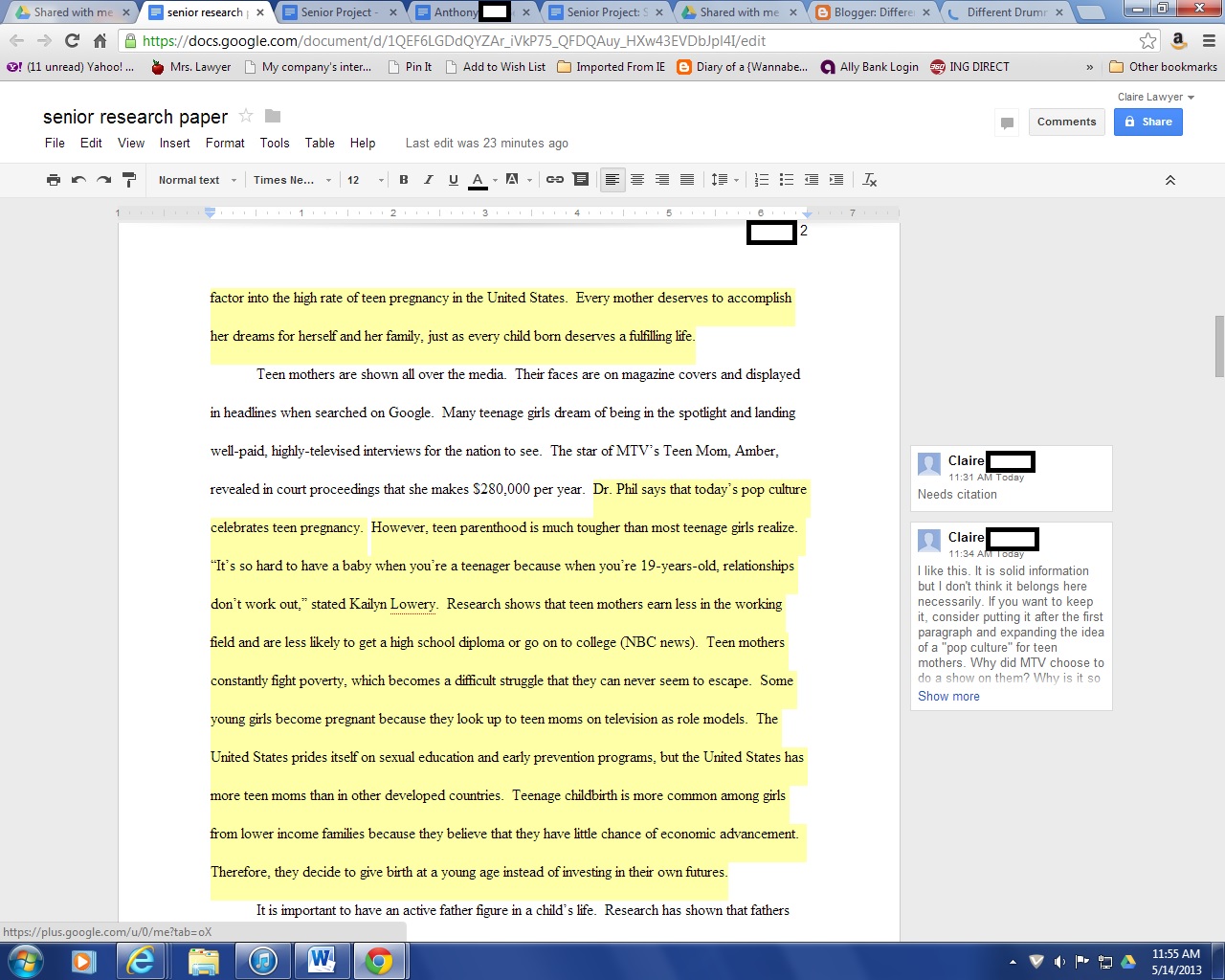
/>Google Docs is one of the best sources of modeling during writing instruction.

I can be at my desk and looking at my student's writing as it happens. This means I can go through each essay, highlight areas that need attention, comment to provide leading questions to help further their thought process, strike through areas that are not needed, and provide "how to" guides for paragraph organization and requirements.

What does this mean for my students?

This means that they can sit at their desk and, in real-time, see their mistakes and how to fix them. Instead of writing an essay turning it in, waiting for the teacher to grade it, having it handed back to them, sitting down AGAIN to re-write it and then beginning the whole process over again, they can see what they are doing wrong and immediately fix it.

Google Docs also has an area for creating forms for assessment that will automatically filter the answers, GRADE the answers, and present you with a filled out assessment sheet that details what students know and what they need additional time and instruction on. It is a life saver when you have a large class and need to quickly see if you can move on to the next topic or if you need to spend a little extra time providing additional information.

Please visit my store on Teachers Pay Teachers.


Related Posts Plugin for WordPress, Blogger...